Building Agents in a Language That Knows What an Agent Is#
Most of an agent codebase is not the agent. It is the supporting code every developer writes from scratch, because the languages we use were never designed for agents.
The Problem#
An agent is a program built around LLM calls. The model does the thinking, and the code around it decides which calls to make, what to do with the results, and what to call next.
Today, most agents are built in Python or TypeScript. These languages were chosen for their ecosystem maturity, not because they were designed for agents. As a result, three problems show up in nearly every agent codebase.
The same intent gets written twice. A tool is a function and a JSON schema describing it. A structured output is a Pydantic class and a response_format argument. If we rename the function but forget the JSON spec, the spec still advertises the old name to the model. If we rename a field but forget the prompt that asks for it, the prompt still references the old one. Nothing in the build catches the mismatch, because the link between the code and the string only exists in the developer's head. Drift is silent until the model misbehaves at runtime.
Control flow lives in prose. When we want an agent to follow a specified workflow, that workflow ends up inside a system prompt in natural language, like "First search, then summarize, then if the summary is too long, revise it." Because the workflow only lives as a string, the code can't enforce or check the steps. There's no way to verify the agent followed the workflow correctly as specified.
The plumbing is rebuilt every project. Every agent codebase needs the same supporting machinery: a ReAct loop for tool use, retry logic around validation errors, a router that dispatches on a classifier output, a threadpool that fans work out and merges results. None of this is the agent's logic, but every team builds it themselves. That wastes engineering time, and bugs in the plumbing are hard to tell apart from bugs in the agent.
These three problems share a root cause. The parts that are the agent, its tools, its workflow, its retries, its parallelism, live in two places: as strings inside prompts, and as code that every team has to write from scratch. Neither place is something the language understands as an agent. So a question:
If agents were a feature of the language itself, instead of being built from prompts and code that developers need to write from scratch, what would the language need to provide?
The answer is already in the Jac programming language. Two ideas power it: Meaning-Typed Programming (MTP), brought in by the byLLM plugin, and Object-Spatial Programming (OSP), Jac's native model for organizing computation around a graph. Together they give us seven patterns for building agents: three for what happens inside a single iteration (the Mind), and four for how work moves between iterations (the Flow). Every agent codebase already implements all seven, just by hand. The rest of this post is what those seven look like when the language has words for them.
About the code
Every Jac snippet below is self-contained and runs with jac run <file>.jac against a configured model. Copy any block, save it, and you'll see the agent execute end-to-end.
The Mind#
Three things any single agent iteration usefully does:
- Generate: LLM returns free text from a function signature.
- Extract: LLM returns typed data validated against a schema.
- Invoke: LLM calls tools in a ReAct loop until it has an answer.
1. Generate#
# Python: an LLM call is an HTTP request with a string
from openai import OpenAI
client = OpenAI()

def answer(question: str) -> str:
    response = client.chat.completions.create(
        model="gpt-4o-mini",
        messages=[
            {"role": "system", "content": "You answer questions about any topic."},
            {"role": "user", "content": question},
        ],
    )
    return response.choices[0].message.content
The Python snippet above describes one function in two places. The signature def answer(question: str) -> str says what the function returns. The system prompt string "You answer questions about any topic." says what it actually does. Rename answer to respond and the prompt still describes the old function. This is exactly the problem we named earlier: the same intent written twice.
# Jac: an LLM call is a function
def answer(question: str) -> str by llm();

with entry {
    response = answer("What are three interesting facts about computer architecture?");
}
In Jac, the intent is written once. The signature def answer(question: str) -> str by llm(); is what the LLM sees. The function name answer, the parameter question, and the return type str together tell the model what to do. Rename the function or the parameter, and the prompt updates with it. byLLM builds the prompt automatically from these code semantics. Jac calls this Meaning-Typed Programming.
2. Extract#
# Python: schema declared twice, once as a type, once as an API argument
from pydantic import BaseModel
from enum import Enum
from openai import OpenAI

class Topic(str, Enum):
    HARDWARE = "HARDWARE"; SOFTWARE = "SOFTWARE"
    NETWORKS = "NETWORKS"; AI = "AI"; OTHER = "OTHER"

class PaperClassification(BaseModel):
    topic: Topic
    one_line_summary: str
    key_contributions: list[str]

def classify_paper(title: str, abstract: str) -> PaperClassification:
    response = OpenAI().beta.chat.completions.parse(
        model="gpt-4o-mini",
        messages=[
            {"role": "system", "content": "Classify a research paper..."},
            {"role": "user", "content": f"Title: {title}\n\nAbstract: {abstract}"},
        ],
        response_format=PaperClassification,
    )
    return response.choices[0].message.parsed   # may be None, must check
The Python snippet above needs several moving parts just to return a typed object. The schema lives in a Pydantic class, PaperClassification. OpenAI's beta parse endpoint takes that same class again as response_format=. The return value is still optional, so every caller writes a defensive check (# may be None, must check). Malformed JSON forces a hand-rolled try/except and retry loop on top of all that. The schema, the beta endpoint, the optional check, the retry, every developer rebuilds this wrapper for every structured-output call.
In Jac:
enum Topic { HARDWARE, SOFTWARE, NETWORKS, AI, OTHER }

obj PaperClassification {
    has topic: Topic;
    has one_line_summary: str;
    has key_contributions: list[str];
}

def classify_paper(title: str, abstract: str) -> PaperClassification by llm();
sem classify_paper = "Classify a research paper by its title and abstract.";

with entry {
    result = classify_paper(
        title="Attention Is All You Need",
        abstract="The dominant sequence transduction models are based on..."
    );
    # result.topic is a Topic enum member, result.key_contributions is list[str]
}
In Jac, the return type PaperClassification is the schema. The runtime introspects it, sends it to the model, validates the response, and retries automatically with the validation error in scope. The developer never writes the try / json.loads / pydantic.ValidationError block by hand, because the runtime handles it.
3. Invoke#
# Python: hand-rolled ReAct
TOOLS = [
    {"type": "function", "function": {
        "name": "search_papers",
        "description": "Search for academic papers by query.",
        "parameters": {"type": "object",
            "properties": {"query": {"type": "string"}},
            "required": ["query"]}}},
    # ... two more, declared by hand
]
DISPATCH = {"search_papers": search_papers, ...}

def research(query: str) -> str:
    messages = [{"role": "system", "content": "Research..."},
                {"role": "user",   "content": query}]
    while True:                                          # the loop, by hand
        msg = client.chat.completions.create(...).choices[0].message
        messages.append(msg.model_dump(exclude_none=True))
        if not msg.tool_calls: return msg.content        # the stop, by hand
        for call in msg.tool_calls:                      # the dispatch, by hand
            args = json.loads(call.function.arguments)
            result = DISPATCH[call.function.name](**args)
            messages.append({"role": "tool",
                             "tool_call_id": call.id,
                             "content": str(result)})
The Python snippet above shows two of our problems at once. search_papers is declared three times: once as the actual function, once in the TOOLS list as a JSON schema, and once in the DISPATCH dict as a string key. Renaming the function means manually updating it in all three places. The developer also has to write the entire tool-use loop by hand, repeatedly calling the model, running the tool it requests, sending the result back, and continuing until the model is done. Every developer building a tool-using agent writes this same loop themselves.
In Jac:
# Tool stubs (in a real app these'd hit an API)
def search_papers(query: str) -> str { return f"3 papers found for '{query}'"; }
def get_citations(paper_id: str) -> int { return len(paper_id) * 100; }
def summarize_abstract(text: str) -> str { return f"Summary of: {text[:30]}..."; }

def research(query: str) -> str by llm(
    tools=[search_papers, get_citations, summarize_abstract]
);
sem research = "Research a topic by searching papers, checking citations, and summarizing findings.";

with entry {
    findings = research("Recent papers on transformer architectures and their citation impact");
}
In Jac, tools are ordinary functions. The runtime introspects their signatures, exposes them to the model, runs the tool-use loop, and returns when the model is done. The developer never declares a JSON schema, never maintains a dispatch dict, and never writes the tool-use loop by hand.
Together, these three patterns address two of our problems for anything that happens inside a single iteration: declaring the same intent in multiple places, and rewriting the same supporting code in every project. The moment two iterations need to coordinate, the wiring between them becomes the agent. One iteration's output feeds the next, a retry triggers a rerun, or several workers run in parallel.
In Python or TypeScript, this wiring lives inside a generic for loop or inside a system prompt with numbered steps. That is the third problem, control flow lives in prose, and the next four patterns address it.
The Flow#
Four kinds of wiring between Mind iterations:
- Pipe: sequential composition. One call's output is the next call's input.
- Route: pick which handler runs based on what came in.
- Loop: repeat until a typed quality check passes.
- Spawn: fan out parallel work, fan in the results.
1. Pipe#
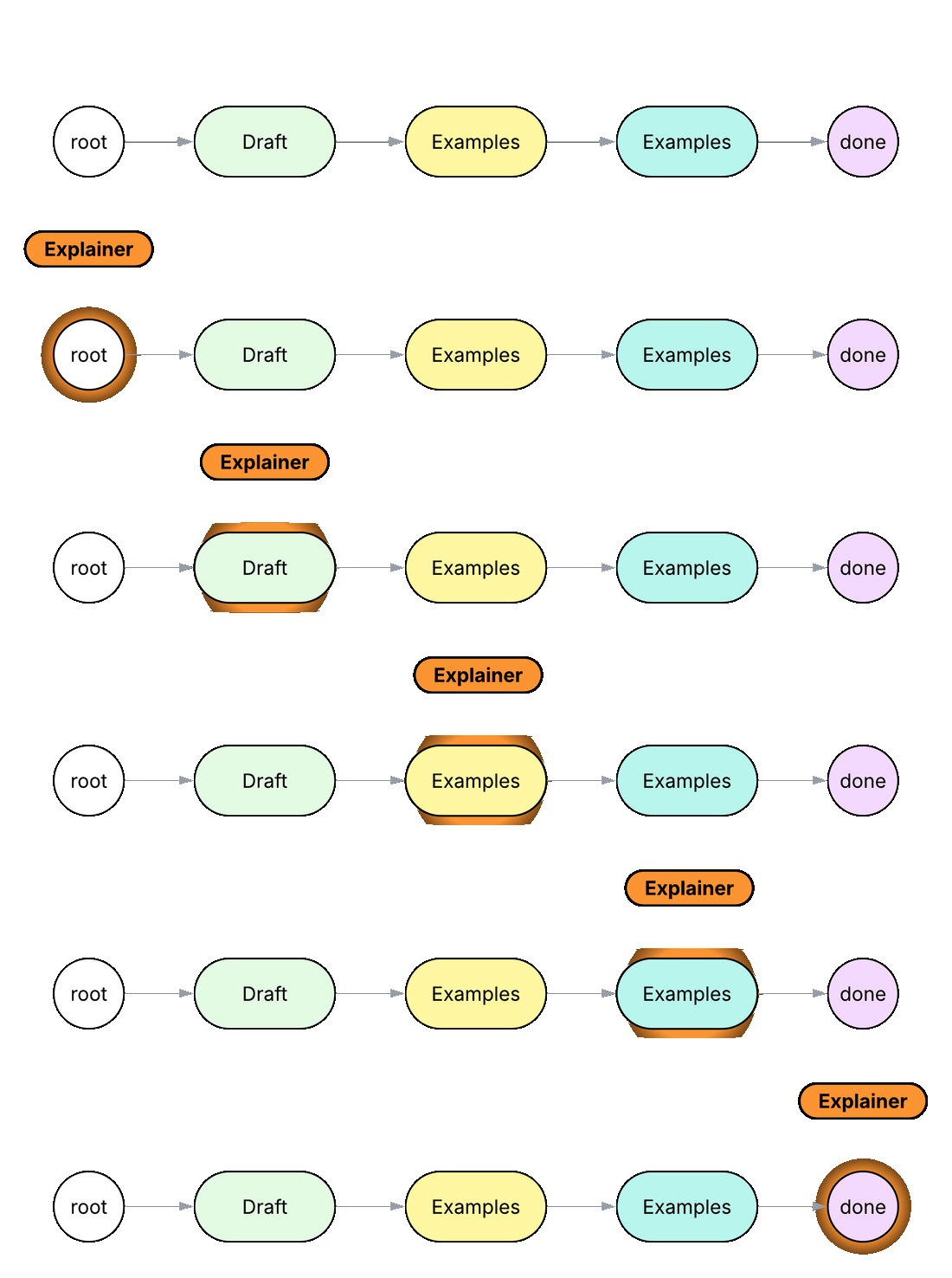
node Draft    { def run(topic: str) -> str by llm(); }
node Examples { def run(draft: str) -> str by llm(); }
node Summary  { def run(detail: str) -> str by llm(); }
node Done     {}

walker Explainer {
    has topic: str;
    has text: str = "";

    can do_draft with Draft entry {
        self.text = here.run(self.topic);
        visit [-->];
    }
    can do_examples with Examples entry {
        self.text = here.run(self.text);
        visit [-->];
    }
    can do_summary with Summary entry {
        self.text = here.run(self.text);
        visit [-->];
    }
}

with entry {
    draft = Draft();  ex = Examples();  summ = Summary();  done = Done();
    root ++> draft;  draft ++> ex;  ex ++> summ;  summ ++> done;
    root spawn Explainer(topic="How cache coherence works in multicore processors");
}
In Python or TypeScript, a workflow like this normally lives inside one system prompt with numbered steps, and the model is left to decide on its own whether each step was followed. In the Jac code above, each step is its own node (Draft, Examples, Summary), connected by the edges root ++> draft ++> ex ++> summ ++> done. The walker Explainer visits each node in order, calling its run method and carrying the result forward in self.text. Each step has its own scoped prompt that only sees the data the walker carries. Inserting a new step means adding a node and an edge instead of editing a prompt.
2. Route#
node HardwareExpert {
    has description: str = "Expert in CPU, GPU, memory hierarchies, chip fabrication";
    def answer(q: str) -> str by llm();
    can respond with ResearchAssistant entry {
        visitor.response = self.answer(visitor.query);
    }
}
node SoftwareExpert {
    has description: str = "Expert in compilers, operating systems, runtimes";
    def answer(q: str) -> str by llm();
    can respond with ResearchAssistant entry {
        visitor.response = self.answer(visitor.query);
    }
}
node AIExpert {
    has description: str = "Expert in neural networks, LLMs, machine learning systems";
    def answer(q: str) -> str by llm();
    can respond with ResearchAssistant entry {
        visitor.response = self.answer(visitor.query);
    }
}

walker ResearchAssistant {
    has query: str;
    has response: str = "";
    can route with Root entry {
        visit [-->] by llm(incl_info={"User query": self.query});
    }
}

with entry {
    root ++> HardwareExpert();
    root ++> SoftwareExpert();
    root ++> AIExpert();

    q = "How do branch predictors work in modern CPUs?";
    r = root spawn ResearchAssistant(query=q);
}
In Python or TypeScript, branching between specialists normally requires three pieces: a classifier prompt that picks a label, a dispatch dictionary that maps each label to a handler function, and the handler functions themselves with their own prompts. Adding a new specialist means updating these three pieces. In the Jac code above, each specialist is a node with a description field (HardwareExpert, SoftwareExpert, AIExpert). The line visit [-->] by llm(incl_info={"User query": self.query}) lets the model read each connected node's description and pick which one to visit. Adding a new specialist means adding one node with a description, without touching a prompt or a dispatch table.
3. Loop#
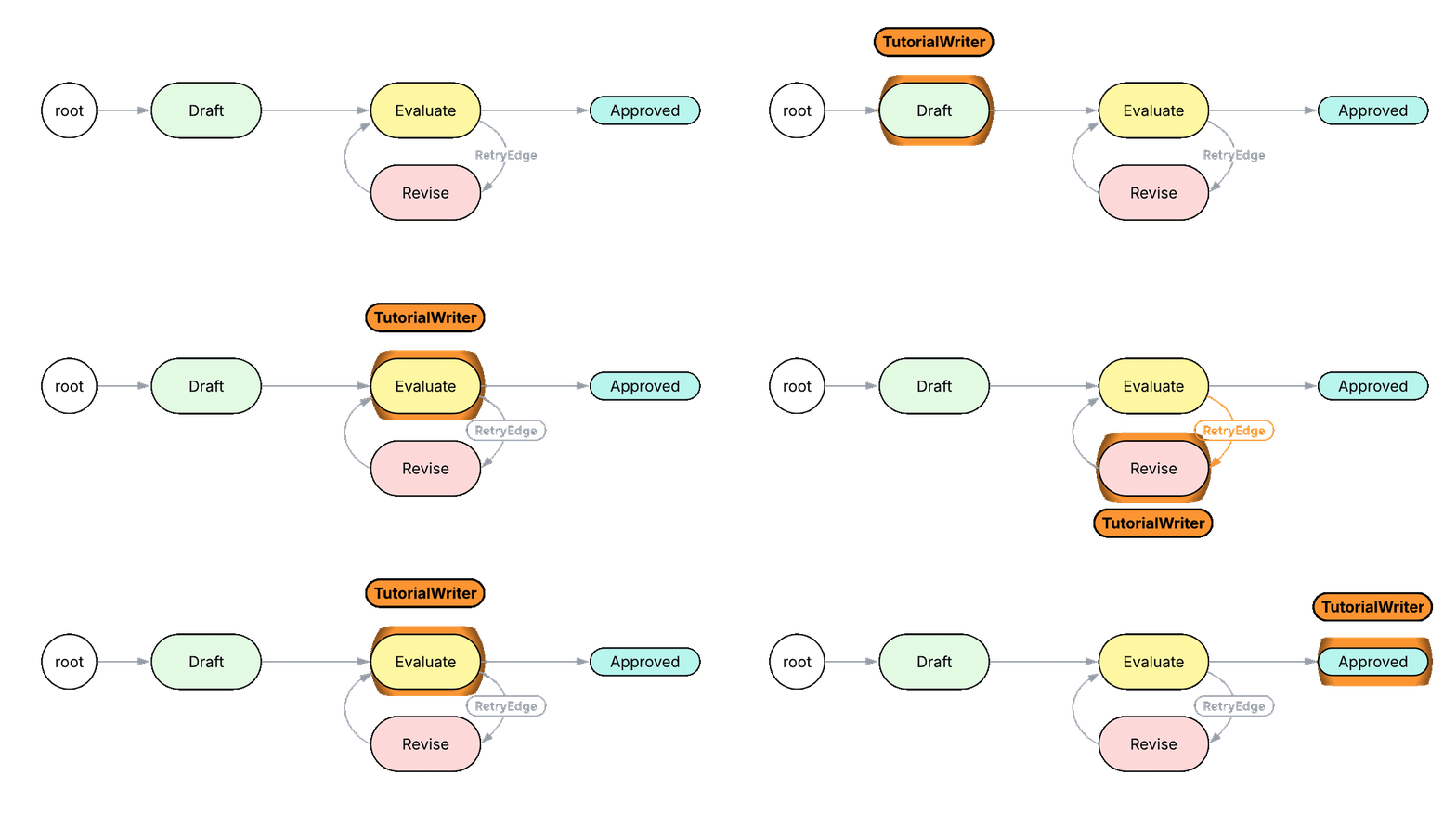
enum Quality { GOOD, NEEDS_IMPROVEMENT }

obj Review {
    has quality: Quality;
    has weaknesses: list[str];
    has suggestion: str;
}

edge RetryEdge {
    has reason: str = "Verdict was NEEDS_IMPROVEMENT";
    has max_retries: int = 3;
}

node Draft    { def run(topic: str) -> str by llm(); }
node Evaluate { def run(draft: str, topic: str) -> Review by llm(); }
node Revise   { def run(draft: str, feedback: str) -> str by llm(); }
node Approved {}

walker TutorialWriter {
    has topic: str;
    has draft: str = "";
    has feedback: str = "";
    has version: int = 1;

    can do_draft with Draft entry {
        self.draft = here.run(self.topic);
        visit [-->];
    }

    can do_evaluate with Evaluate entry {
        review = here.run(self.draft, self.topic);
        if review.quality == Quality.GOOD {
            visit [-->][?:Approved];
        } else {
            self.feedback = f"{review.weaknesses}. {review.suggestion}";
            visit [->:RetryEdge:->];
        }
    }

    can do_revise with Revise entry {
        self.version += 1;
        self.draft = here.run(self.draft, self.feedback);
        visit [-->];
    }
}

with entry {
    draft = Draft();   eval_n = Evaluate();
    revise = Revise(); done   = Approved();

    root ++> draft ++> eval_n;
    eval_n ++> done;
    eval_n +>:RetryEdge:+> revise;
    revise ++> eval_n;

    root spawn TutorialWriter(topic="How cache coherence works in multicore processors");
}
In Python or TypeScript, this normally takes a while loop with an exit condition that matches against a substring in the model's reply (if 'GOOD' in response: break) and a magic number for the maximum retry count. The intent of the loop, that this is a critique-and-revise cycle, lives only in a comment. In the Jac code above, the loop is a named edge RetryEdge between the Evaluate and Revise nodes, declared as eval_n +>:RetryEdge:+> revise. A reader scanning the graph immediately sees what kind of loop this is. The exit condition rides on a typed Quality verdict returned by Evaluate, not on a string match, and the maximum retry count is a typed field on the edge rather than a magic number in a function body.
4. Spawn#

def search_papers(query: str) -> str { return f"papers on '{query}'"; }
def get_citations(paper_id: str) -> int { return 1247; }

walker HardwareResearcher {
    has topic: str;
    has result: str = "";
    def investigate(topic: str) -> str by llm(tools=[search_papers, get_citations]);
    can start with Root entry {
        self.result = self.investigate(self.topic);
    }
}
walker SoftwareResearcher {
    has topic: str;
    has result: str = "";
    def investigate(topic: str) -> str by llm(tools=[search_papers, get_citations]);
    can start with Root entry {
        self.result = self.investigate(self.topic);
    }
}
walker AIResearcher {
    has topic: str;
    has result: str = "";
    def investigate(topic: str) -> str by llm(tools=[search_papers, get_citations]);
    can start with Root entry {
        self.result = self.investigate(self.topic);
    }
}

walker SurveyAgent {
    has topic: str;
    has response: str = "";
    def synthesize(topic: str, hw: str, sw: str, ai: str) -> str by llm();

    can start with Root entry {
        hw_task = flow root spawn HardwareResearcher(topic=self.topic);
        sw_task = flow root spawn SoftwareResearcher(topic=self.topic);
        ai_task = flow root spawn AIResearcher(topic=self.topic);

        hw: any = wait hw_task;
        sw: any = wait sw_task;
        ai: any = wait ai_task;

        self.response = self.synthesize(self.topic, hw.result, sw.result, ai.result);
    }
}

with entry {
    root spawn SurveyAgent(topic="Efficient inference for large language models");
}
In Python or TypeScript, parallel work usually collapses into either a single bloated prompt holding all the tools and asking the model to manage them itself, or a hand-rolled threadpool with manual result merging. In the Jac code above, SurveyAgent spawns three independent walkers (HardwareResearcher, SoftwareResearcher, AIResearcher) using flow root spawn, then collects their results with wait. Each researcher carries its own scoped tool list and its own context, so three focused prompts run concurrently rather than one bloated prompt holding nine tools. The synthesis step self.synthesize(...) only runs after all three workers have completed.
Together, these four patterns address the third of our problems: workflows that live inside a prompt as a string and cannot be verified or observed by the surrounding code. In Jac, the workflow is the graph itself, where the steps, branches, retries, and parallelism are all visible as connections between nodes. The seven patterns, three for what happens inside an iteration and four for how iterations connect, cover what every agent codebase rebuilds by hand in Python or TypeScript.
The Takeaway#
The seven Mind and Flow patterns map directly onto the three problems we started with.
| The problem | How Jac addresses it |
|---|---|
| The same intent written twice. Tool schemas and structured-output classes have to be declared in code and described again in prompts or JSON specs, with nothing keeping the two halves in sync. | The Mind patterns keep intent in one place. The function signature itself becomes the prompt that the model receives. The return type defines the schema for structured output. Tools are simply ordinary functions whose signatures the runtime introspects. byLLM uses all of this to build the prompt automatically. |
| Control flow lives in prose. Workflows, routing decisions, retry conditions, and parallelism end up inside system prompts as English, where no code can verify whether the model followed them. | The Flow patterns express workflows as graph structure. Pipelines, branches, retries, and parallel fan-outs are all visible as connections between nodes, observable by the runtime and readable by the developer. |
| The plumbing is rebuilt every project. Every team writes its own ReAct loop, its own validation-and-retry, its own router, and its own threadpool, and ships its own bugs in them. | byLLM and OSP handle this plumbing in the runtime. The tool-use loop, the validation-and-retry, the routing, and the parallel fan-out are features of the language rather than code every team writes from scratch. |
The agents people are actually shipping aren't here yet. The most prominent open-source projects are all in Python or TypeScript:
- OpenClaw: personal assistant across 20+ chat channels (TypeScript)
- Hermes (Nous Research): self-improving agent (Python)
- OpenCode: open-source coding agent (TypeScript)
Those languages weren't chosen because they fit agents. They were chosen for ecosystem maturity. The cost is that every team rebuilds the same supporting code, and the codebase bloats around the missing patterns.
With these patterns in the language, building an agent is just building the agent.